A croissant looks like the simplest thing in a bakery case, a golden crescent, and it is one of the most labor-intensive. The pastry is laminated, meaning butter is folded into dough over and over until the two form a stack of alternating layers, and in the oven the water in the butter turns to steam and pushes those layers apart. Bakeries in Charlotte that make their croissant dough in-house, as Villani's Bakery does for its plain, chocolate, almond, and pistachio croissants, are signing up for a process that spans parts of two or three days for a pastry that sells out by mid-morning.
Understanding the process changes how you judge, buy, and store the result.
The layers, counted
The arithmetic of lamination is neat: each fold multiplies the layers by three. A butter block enclosed in dough starts as a handful of layers; three folds later you have the classic twenty-seven layers of dough, with butter between them all. More folds are not better. Push past the classic count and the layers get so thin that butter and dough merge into something closer to a rich bread, and the distinct, shattering leaves are lost.
Why it takes so long
The enemy in lamination is temperature, and the clock is mostly refrigeration. Butter must be cold enough to stay in sheets and warm enough to flex without cracking. Dough must rest between folds so the gluten relaxes and the rolling does not tear the layers. Then the shaped croissants proof, slowly rising until they jiggle like set custard, and underproofed or overproofed croissants both fail in the oven, one dense, one collapsed into their own butter. A scratch bakery builds its mornings around these rests, starting long before the doors open; at Villani's the owners describe a 3 a.m. hustle, and croissants are a large part of why.
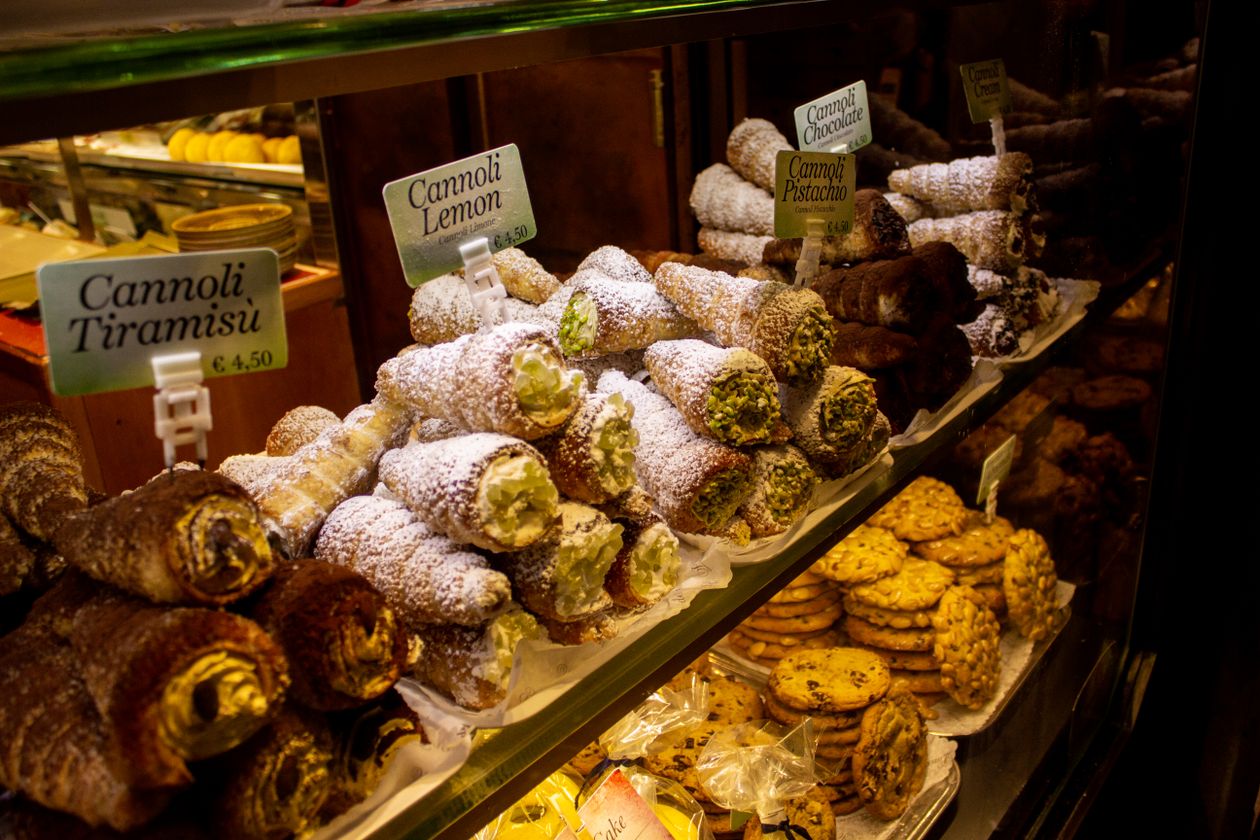
Filled croissants are variations on the same discipline. A chocolate croissant wraps the laminated dough around batons of dark chocolate. An almond croissant is often a second life for a plain one, split, filled with almond cream, and baked again with sliced almonds on top, a thrifty French tradition that became a beloved pastry in its own right. Pistachio and mascarpone-filled versions, like the strawberry and lemon mascarpone croissants on Villani's menu, are the modern bakery dialect of the same language.
Judging and keeping a croissant
A good croissant announces itself. The exterior should be deep golden and crisp enough to shatter slightly when squeezed, shedding flakes. The interior, torn open, should show a honeycomb of airy layers, not a bready crumb. It should smell of butter, not of fryer oil or yeast. Weight is a quiet clue: a croissant should feel light for its size, because much of its volume is air between layers.

At home, croissants are best the day they are baked, revived with a few minutes in a moderate oven, never a microwave, which turns the layers leathery. Day-old croissants have honorable second careers: split and toasted, made into breakfast sandwiches, or, following the almond croissant's example, rebaked with a filling. What they should not do is sit in a sealed bag on the counter for three days pretending nothing has changed.
A short history folded into the dough
The croissant's ancestry runs through the Austrian kipferl, a crescent-shaped roll that predates it, and the laminated version took shape in Paris in the nineteenth century, when bakers combined the shape with the French technique of folding butter into dough that also produces puff pastry and the Danish pastry family. The crescent survived every revision because it is practical as much as symbolic: it bakes evenly, tears by hand along its sections, and shows off the layers at its cut ends. When you tear a croissant at a Charlotte bakery and see the honeycomb, you are looking at a technique that Parisian bakers standardized over generations and that scratch bakers here still perform by hand, one fold at a time, which is why the pastry commands respect out of proportion to its four or five ingredients.
Common questions
How many layers does a croissant have?
A classic croissant has twenty-seven layers of dough, produced by folding a butter block into dough three times, each fold tripling the count.
Why do croissants take so long to make?
The dough and butter must be chilled and rested between folds to keep the layers separate, and the shaped pastries need a slow proof. The process spans parts of two or three days.
How do I refresh a day-old croissant?
Warm it in a moderate oven for a few minutes to re-crisp the layers. Avoid the microwave, which makes laminated pastry tough and leathery.
Photos in this guide are representative stock images.
← All guides from Villani's Bakery← Back to Villani's Bakery